Prepared by the Research Department at lawionyrs
Under the Supervision of Muayid Al-Din Al-Sadiq Malli
The Escalating Threat of Deepfake Fraud Is Reshaping the Concept of Digital Trust and Global Cybersecurity
Introduction
On May 18, 2026, international warnings intensified following the circulation of cybersecurity and technology reports revealing the use of Deepfake technologies in financial fraud operations and sophisticated cyberattacks targeting corporations, government institutions, and public figures across the United States, Europe, Asia, and the Middle East.
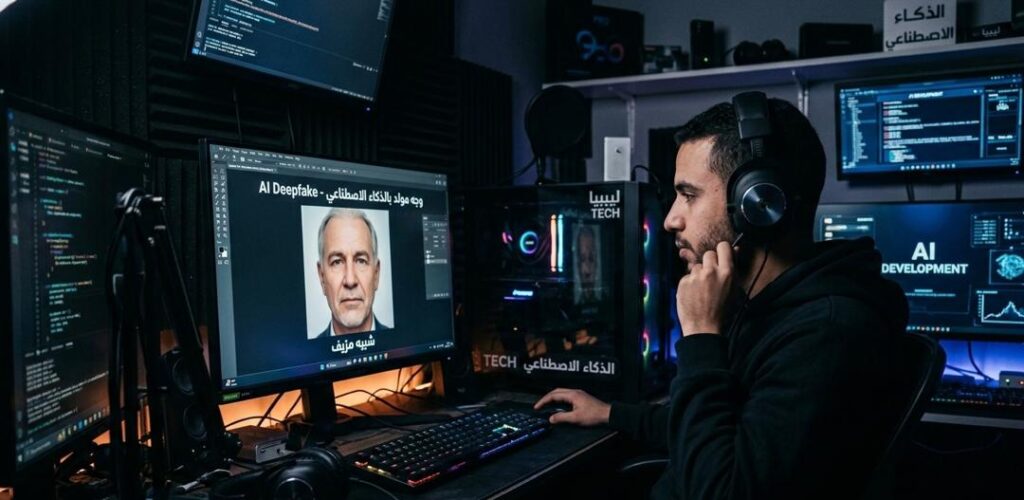
One recent incident sparked widespread global controversy after a highly realistic fake video of a senior executive at an international financial company was used to authorize fraudulent financial transfers before the manipulation was later discovered. Investigations revealed that the attack relied on advanced artificial intelligence models capable of replicating voices and facial expressions with near-realistic accuracy.
These developments are considered among the most dangerous modern technological and legal challenges because they directly affect:
• Digital trust
• Cybersecurity
• Digital identity
• Visual and voice verification
• Digital evidence
• Institutional security
• Media and informational stability
Recent reports issued by the World Economic Forum, Europol, and the Cybersecurity and Infrastructure Security Agency (CISA) indicated that Deepfake technologies are increasingly being used in:
• Financial fraud
• Social engineering
• Media disinformation
• Digital extortion
• Identity impersonation
• Political manipulation
⸻
First: The Concept of Deepfake Technology and Its Technical Evolution
Deepfake refers to the use of artificial intelligence and deep learning technologies to create fake audio, visual, or textual content that appears highly realistic.
These systems rely on:
• Generative Adversarial Networks (GANs)
• Voice Cloning Systems
• Facial Synthesis Technologies
• Neural Rendering
• Large Multimodal AI Models
to produce media that is difficult to distinguish from authentic content.
Research published by the Massachusetts Institute of Technology (MIT) and Stanford University showed that advancements in generative AI models during 2025 and 2026 significantly reduced the cost of producing fake media while dramatically increasing realism and precision.
Reports from OpenAI and Google DeepMind also indicated that multimodal AI systems are now capable of:
• Analyzing facial expressions
• Replicating vocal patterns
• Generating complete conversations
• Simulating public figures
which has made detecting fake content increasingly difficult.
⸻
Second: Legal and Regulatory Challenges
From a legal perspective, Deepfake-related crimes raise complex challenges concerning:
• Verification of digital identity
• Admissibility of electronic evidence
• Criminal liability
• Privacy rights
• Electronic fraud
• Digital defamation
• National security
Reports issued by the European Parliament and the United Nations Office on Drugs and Crime (UNODC) discussed the risks associated with the use of Deepfake technologies in transnational crimes, especially amid the absence of unified international legislation regulating such technologies.
Legal studies from Harvard Law School and the Oxford Internet Institute demonstrated that judicial systems are facing growing difficulties in:
• Verifying the authenticity of digital evidence
• Distinguishing real content from fabricated material
• Determining legal responsibility
• Prosecuting cross-border crimes
In May 2026, European and American regulatory bodies began discussing updates to laws related to:
• Digital identity
• Cybersecurity
• Artificial intelligence
• Data protection
• Cybercrime
in response to the rapid escalation of these threats.
⸻
Third: Deepfake Fraud and Financial Crime
Recent months have witnessed a sharp increase in the use of Deepfake Fraud technologies within the financial sector.
Reports from the Federal Bureau of Investigation (FBI) and Interpol revealed a rise in attacks involving:
• Executive voice impersonation
• Fake banking identities
• Fabricated video meetings
• Manipulation of biometric verification systems
with the objective of conducting fraudulent financial transfers or accessing sensitive information.
Deloitte and KPMG also warned that financial institutions are now facing emerging threats known as:
• Synthetic Identity Fraud
• AI-Driven Financial Manipulation
where entirely artificial digital identities are generated using AI technologies.
Research published by Carnegie Mellon University demonstrated that Deepfake technologies could weaken the effectiveness of:
• Face Recognition
• Voice Authentication
• Remote Identity Verification
unless more advanced detection mechanisms are developed.
⸻
Fourth: Media and Political Implications
The risks associated with Deepfake technologies are no longer limited to financial crimes but have expanded into:
• Digital media
• Political security
• Public opinion
• Information warfare
Reports from the NATO Strategic Communications Centre of Excellence and the World Economic Forum warned that the use of fabricated videos during elections or political crises could result in:
• Destabilization
• Spread of disinformation
• Market manipulation
• Erosion of trust in institutions
Studies published in Nature and by the MIT Media Lab further demonstrated that fake content often spreads across digital platforms faster than authentic content due to its emotional and media impact.
⸻
Fifth: Ethical and Religious Dimensions
Within the framework of Islamic jurisprudence, Deepfake technologies used for deception, fraud, or defamation constitute forms of:
• Fraud
• Misrepresentation
• False testimony
• Violations against reputation and rights
which directly contradict principles of:
• Honesty
• Integrity
• Protection of rights
• Prevention of harm
• Protection of society
The use of artificial intelligence to mislead individuals or institutions also raises increasing ethical and legal responsibilities regarding the regulation of advanced technologies.
⸻
Sixth: Modern Technological and Regulatory Solutions
At the technological level, companies and research institutions have begun developing advanced tools for detecting fake content, including:
• AI Deepfake Detection Systems
• Digital Watermarking
• Content Authentication Protocols
• Biometric Verification Layers
• Blockchain-Based Media Verification
Reports from Microsoft, Adobe, and Google DeepMind emphasized the importance of developing:
• Content Credentials
• Digital Provenance Systems
• Authenticity Metadata Standards
to verify the origin of digital content before its dissemination.
Research from the MIT Computer Science and Artificial Intelligence Laboratory and the University of California Berkeley also showed that combining:
• Neural pattern analysis
• Digital signatures
• Adversarial machine learning
could significantly improve Deepfake detection capabilities.
⸻
Seventh: Analytical Conclusion
It is evident that Deepfake technologies are no longer merely experimental or entertainment tools, but have evolved into strategic threats affecting:
• Cybersecurity
• The digital economy
• Institutional trust
• Judicial systems
• Political security
• Digital identity
The rapid advancement of generative artificial intelligence during 2025 and 2026 suggests that the world is approaching an era in which verifying digital truth may become an increasingly complex daily challenge.
⸻
Findings
- Deepfake technologies have become one of the most dangerous modern cybersecurity threats.
- AI-driven financial fraud is rapidly escalating worldwide.
- Current legal systems face growing difficulties in keeping pace with fake digital content.
- Digital identity and electronic evidence are increasingly vulnerable to manipulation.
- Artificial intelligence is reshaping the concept of digital trust globally.
- Media, politics, and financial markets are increasingly exposed to visual and audio disinformation.
- Technological and regulatory solutions require urgent international integration.
⸻
Recommendations
- Develop specialized international legislation addressing Deepfake crimes and digital identity fraud.
- Require digital platforms to implement fake-content detection technologies.
- Strengthen multilayer biometric verification systems.
- Support research on Deepfake Fraud detection and digital content analysis.
- Establish global standards for verifying digital content authenticity.
- Enhance cooperation between governments, technology companies, and academic institutions.
- Raise public awareness regarding digital disinformation and AI-driven fraud risks.
⸻
Open Question
As generative artificial intelligence technologies continue to evolve rapidly, will the world succeed in building a digital verification framework capable of protecting truth and public trust, or will the era of “synthetic reality” make distinguishing between real and fake more difficult than ever before?
⸻
Sources
• World Economic Forum reports on Deepfake risks and digital security
• Europol reports on cybercrime and digital identity
• Cybersecurity and Infrastructure Security Agency (CISA) reports on modern digital threats
• Federal Bureau of Investigation (FBI) reports on AI-related financial fraud
• Interpol reports on transnational cybercrime
• Research by the Massachusetts Institute of Technology (MIT) on generative AI and media analysis
• Research by Stanford University on Deepfake Detection and digital simulation technologies
• Reports from OpenAI and Google DeepMind on multimodal AI models
• Harvard Law School research on AI legal challenges
• Oxford Internet Institute studies on digital identity and information disinformation
• Reports from Microsoft and Adobe on digital content authentication systems
• Research published in Nature and by the MIT Media Lab on the spread of digital misinformation
• NATO Strategic Communications Centre of Excellence reports on information warfare and Deepfakes
Deepfake, Deepfake Fraud, Artificial Intelligence, Cybersecurity, Digital Fraud, Digital Identity, Media Disinformation, Voice Cloning, Visual Manipulation, Cybercrime, Information Security, Generative AI, Digital Verification, Technological Crimes, Data Protection, Digital Evidence, Digital Security, Deepfake Detection, AI Fraud, Cybersecurity, Digital Identity, Synthetic Media, AI Generated Content, Information Security, Digital Trust, Biometric Security, Voice Cloning, Facial Recognition, AI Governance, Cyber Crime, Media Manipulation, AI Regulation, Information Warfare, Digital Forensics, Online Fraud, Artificial Intelligence Law, Digital Verification, AI Ethics, Content Authentication, Digital Evidence
For more professional articles addressing similar topics, search the Articles section on the official website of our company lawionyrs, specialized in training, consulting, research, and publishing services within an international legal framework. You may also explore accredited courses through the Courses section, visual content through the Video section, books through the Books section, and additional services through the homepage by selecting the appropriate category.