Prepared by the Research Department at Lawionyrs
Under the supervision of muayid uldin Al-Sadiq malli
Introduction
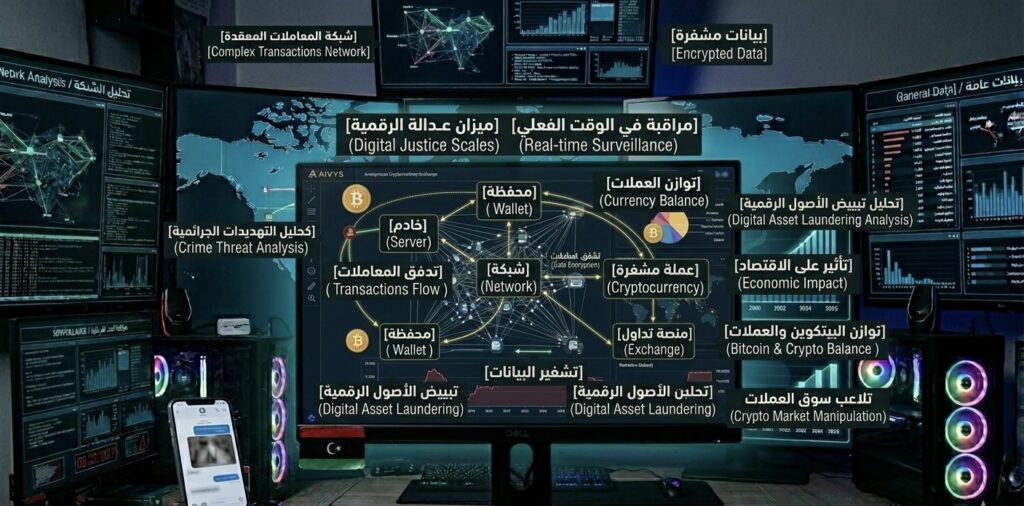
On December 7, 2025, a European regulatory body announced the tracking of a complex financial network that transferred millions of dollars through multiple digital wallets, using cryptocurrencies to conceal the source of illicit funds. Following extensive investigations, it was revealed that this network was laundering proceeds from cybercrimes and international fraud, capitalizing on the difficulty of tracking digital transactions and their high speed of cross-border movement.
I. The Concept of Money Laundering via Digital Currencies
This incident serves as a prominent example of money laundering through digital currencies, which has become one of the most dangerous financial crimes in the modern digital economy. Money laundering is no longer limited to traditional methods; it has evolved to include advanced techniques based on blockchain and cryptocurrencies, making the tracking of illicit funds significantly more complex.
This crime relies on converting illegal funds into digital assets and then redistributing them across multiple trading platforms and wallets to hide their true origin—a process known as “Digital Money Laundering.”
II. Tools and Techniques Used
Reports issued by the Financial Action Task Force (FATF) indicate a significant rise in the use of digital currencies for money laundering, particularly with the emergence of advanced tools such as “Mixers” and “Privacy Coins,” which are used to anonymize users and complicate tracking operations.
III. Legal Issues
From a legal perspective, money laundering via digital currencies raises complex issues regarding the characterization of cryptocurrencies: are they considered traditional money or independent digital assets? This distinction affects the classification of the crime and the prescribed penalties. Furthermore, proving the link between illicit funds and digital transactions is difficult due to the use of encryption technologies.
In this context, studies by the International Monetary Fund (IMF) show that the absence of a unified legal and regulatory framework for digital currencies contributes to creating an environment conducive to the spread of financial crimes, most notably money laundering.
Additionally, World Bank reports confirm that technology-related financial crimes pose a direct threat to the stability of global markets, especially given the rapid expansion of digital currency usage without sufficient oversight.
IV. The Sharia Perspective
In comparison with Islamic Sharia, money laundering is considered a form of concealing “Haram” (forbidden) money and attempting to grant it legitimacy. Such actions are prohibited because they constitute an assault on the financial system and cause harm to society, reinforcing the necessity of clearly criminalizing them within modern legal frameworks.
V. International and Technical Efforts
At the international organizational level, INTERPOL reports indicate that tracking crimes related to digital currencies requires the use of advanced analytical tools based on Artificial Intelligence (AI) and Big Data analysis to monitor suspicious patterns.
Research from the Massachusetts Institute of Technology (MIT) has also shown that “Blockchain Analysis” techniques are among the most important modern tools for uncovering money laundering operations, despite the challenges associated with anonymity.
VI. Analytical Summary
In light of the above, it is clear that money laundering via digital currencies represents a qualitative evolution in financial crimes. It has become more organized and complex, necessitating an integrated legal and technical response based on international cooperation and the updating of legislation.
Findings
- Money laundering via digital currencies represents a growing threat to the global economy.
- The difficulty of tracking digital transactions complicates legal enforcement efforts.
- The lack of a unified legal framework contributes to the spread of this crime.
- Technology is used both as a tool for crime and as an effective means to combat it.
- International cooperation is a decisive factor in curbing digital financial crimes.
Recommendations
- Developing modern legislation that clearly regulates the use of digital currencies.
- Enhancing international cooperation in combating digital money laundering.
- Utilizing data analysis techniques and AI to monitor suspicious activities.
- Mandating trading platforms to implement “Know Your Customer” (KYC) standards.
- Training legal personnel to handle complex digital financial crimes.
Open Question
In light of this rapid development of digital currencies, is it possible to build a global legal system capable of tracking illicit funds, or will these technologies continue to provide a safe haven for organized crime?
Sources
- Financial Action Task Force (FATF) reports on money laundering.
- International Monetary Fund (IMF) studies on digital currencies.
- World Bank reports on financial crimes.
- INTERPOL reports on digital crimes.
- Massachusetts Institute of Technology (MIT) research on blockchain analysis.
For more professional articles on these topics, visit the articles section on our company website: www.lawionyrs.com, specializing in training, consulting, research, and publishing within an international legal framework. You can also follow certified courses in the Courses section, visual content in the Video section, books in the Books section, and other services via the homepage by selecting the appropriate department.